Friday, March 18, 2005

The Glocal Book:"The Book of Tea" by Okakura Kakuzou(Tenshin)-No.84

ART; Ennoble Mankind

「Nothing is more hallowing than the union of kindered spirits in art.

At the moment of meeting, the art lover transcends himself.

At once he is and is not.

He cathes a glimpse of Infinity, but words cannot voice his delight, for the eye has no tongue.

Freed from the fetters of matter, his spirit moves in the rhythm of things.

It is thus that art becomes askin to religion and ennobles mankind.

It is this which makes a masterpiece something sacred.

In this old days the veneration in which the Japanese held the work of the great artist was intense.

The tea-masters guarded their treasures with religious secrecy, and it was often necessary to open a whole series of boxes, one within another, before reaching the shrine itself-the silken wrapping within whose soft folds lay the holy of holies.

Rarely was the object exposed to view, and then only to the initiated.」
( From the Book of Tea-Art Appreciation, pp.81-82, Charles E. Tuttle Co., Rutland, Vermont, Tokyo, Japan)

I will not necessarily agree to guard their arts with religious secrecy.

It should be open to everybody to ennoble mankind.

Click Please!! Listed on BlogShares


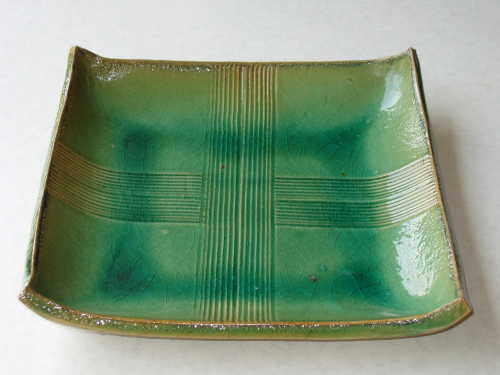
Picture: Blue - Green Glazed Square Plate by Keitoku Kato
Image Designer: Izumi Mori

Thursday, March 10, 2005

The Glocal Book:"The Book of Tea" by Okakura Kakuzou(Tenshin)-No.83

In Art ;Vanity is Fatal to Sympathetic Feeling


「The great masters both of the East and the West never forgot the value of suggestion as a means for taking the spectator into their confidence.

Who can contemplate a masterpiece without being awed by the immense vista of thought presented to our consideration?

How familiar and sympathetic are they all; how cold in contrast the modern commonplaces!

In the former we feel the warm outpouring of a man's heart; in the latter only a formal salute.

Engrossed in his technique, the modern rarely rises above himself.

Like the musicisns who vainly invoked the Lungmen harp, he sings only of himself.

His works may be nearer science, but are further from humanity.

We have an old saying in Japan that a woman cannot love a man who is truly vain, for there is crevice in his heart for love to enter and fill up.

In art vanity is equally fatal to sympathetic feeling, whether on the par of the artist or the public.」
(From the Book of Tea-Art Appreciation, pp.80-81, Charles E. Tuttle Co., Rutland, Vermont, Tokyo, Japan)

The art is the sincere sympathetic heart of humanity.

It should be the feeling of the warm outpouring of a man's heart.

Click Please!! Listed on BlogShares


Picture: Dark Green - Iron Glazed Crock by Keitoku Kato
Image Designer: Izumi Mori

The Glocal Book:"The Book of Tea" by Okakura Kakuzou(Tenshin)-No.82

The More Human the Call
the Deeper is Our Response

「To the sympathetic a masterpiece becomes a living reality towards which we feel drawn in bonds of comradeship.

The masters are immortal, for their loves and fears live in us over and over again.

It is the soul than the hands, the man than the technique, which appeals to us,ーthe more human the call the deeper is our response.

It is because of this secret understanding between the master and ourselves that in poetry or romance we suffer and rejoice with the hero and heroine.

Chikamatsu, our Japanese Shakespeare, has laid down as one of the first principles of dramatic composition the importance of taking the audience into the confidence of the author.

Several of his pupils submitted plays for his approval, but only one of the pieces appealed to him.

It was a play somewhat resembling the Comedy of Errors, in which twin brethren suffer through mistaken identity.

"This," said Chikamatsu, "has the proper spirit of the drama, for it takes the audience into consideration.

This public is permitted to know more than the actors.

It knows where the mistake lies, and pities the poor figures on the board who innocently rush to their fate." 」
( From the Book of Tea-Art Appreciation, pp.79-80, Charles E. Tuttle Co., Rutland, Vermont, Tokyo, Japan)

The artistic values are not simple, but you should ask for eternal beauty at any chances.

Click Please!! Listed on BlogShares


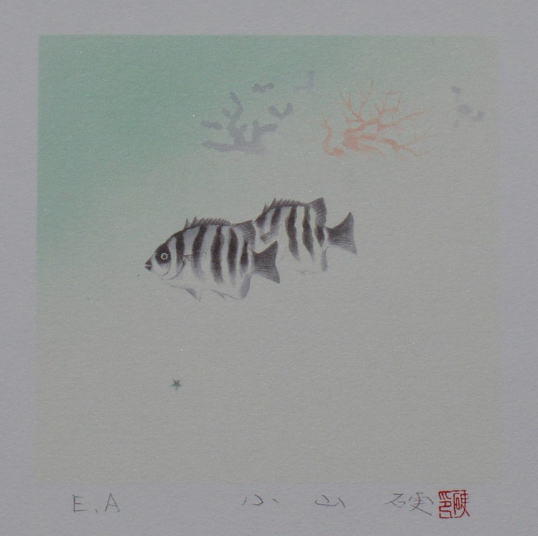
Picture: Striped Porgy by Katashi Oyama
Image Designer: Izumi Mori

Tuesday, March 08, 2005

The Glocal Book:"The Book of Tea" by Okakura Kakuzou(Tenshin)-No.81

The Sympathetic Communion of Minds Necessary for Art Appreciation; Mutual Concession


「The sympathetic communion of minds necessary for art appreciation must be based on mutual concession.

The spectator must cultivate the proper attitude for receiving the message, as the artist must know to impart it.

The tea-muster, Kobori-Enshiu, himself a daimyo, has left to us these memorable words: "Approach a great painting as thou wouldst approach a great prince."

In order to understand a masterpiece, you must lay yourseif low before it and await with bated breath its least utterance.

An eminent Sung critic once made a charming confession.

Said he: "In my young days I praised the master whose pictures I liked, but as my judgment matured I prised myself for liking what the masters had chosen to have me like."

It is to be deplored that so few of us really take pains to study the moods of the masters.

In our stubborn ignorance we refuse to render them this simple courtesy, and thus often miss the rich repast of beauty spread before our very eyes.

A master has always something to offer, while we go hungry solely because of our own lack of appreciation.」
(From the Book of Tea-Art Appreciation, pp.78-79, Charles E. Tuttle Co., Rutland, Vermont, Tokyo, Japan)

I would like to access to the art from my philosophycal sympathetic communication of minds.

Click Please!! Listed on BlogShares


Picture: Olibe Glazed Crock by Keitoku Kato
Image Designer: Izumi Mori

Monday, March 07, 2005

The Glocal Book:"The Book of Tea" by Okakura Kakuzou(Tenshin)-No.80

The Mystery of Art Appreciation


「This story well illustrates the mystery of art appreciation.

The masterpiece is a symphony played upon our finest feelings.

True art is Peiwoh, and we the harp of Lungmen.

At the magic touch of the beutiful the secret chords of our being are awakened, we vibrate and thrill in response to its call.

Mind speaks to mind.

We listen to the unspoken, we gaze upon the unseen.

The master calls forth notes we know not of.

Memories long forgotten all come back to us with a new significance.

Hopes stifled by fear, yearings that we dare not recognise, stand forth in new glory.

Our mind is the canvas on which the artists lay their colour; their pigments are our emotions:; their chiaroscuro the light of joy, the shadow of sadness.

The masterpiece is of ourselves, as we are of the masterpiece. 」
(From the Book of Tea-Art Appreciation, p.78, Charles E, Tuttles Co., Rutland, Vermont, Tokyo, Japan)

I hope to read just this section to understand the way ofthe Art Appreatiation of oriental finest feelings.

Click Please!! Listed on BlogShares


Picture: Blue - Green Glazed Square Platter
Image Designer: Izumi Mori

Sunday, March 06, 2005

The Glocal Book:"The Book of Tea" by Okakura Kakuzou(Tenshin)-No.79

Let Choose the Harp the Song of Theme


「Then Peiwoh changed the key and sang of love.

THe forest swayed like an ardent swain deep lost in thought.

On high, like a haughty maiden, swept a cloud bright and fair; but passing, trailed long shadows on the ground, black like despair.

Again the mode was changed; Peiwoh sang of war, of clashing steel and trapling steeds.

And in the harp arose the tempest of Lungmen, the dragon rode the lightning, the thunderimg avalanche crashed through the hills.

In ecstasy the Celestrial monaech asked Peiwoh wherein lay the secret of his victory.

"Sire, he replied, "others have failed because they sang but of themselves.

I left the hwrp to choose its theme, and knew not truly whether the harp had been Peiwoh or Peiwoh were the harp."」
(From the Book of Tea-Art Appreciation, p.77, Charles E Tuttle Co., Rutland, Vermont, Tokyo, Japan)

The essential philosophy of oriental and/or Japan people is that human being must resonance with nature, but not to fight against nature.

Click Please!! Listed on BlogShares


Picture: Striped Porgy by Keitoku Kato
Image Designer: Izumi Mori

Wednesday, March 02, 2005

The Glocal Book:"The Book of Tea" by Okakura Kakuzou(Tenshin)-No.78

The Prince of Harpists; Playing of
Nature & Seasons;
Awake all the Memories of the Old Kiri Tree

「At last came Peiwoh, the prince of harpists.

With tender hand he caressed the harp as one might seek to soothe an unruly horse, and softly touched the chords.

He sang of nature and the seasons, of high mountains and flowing waters, and all the memories of the tree awoke!

Once more the sweet breath of spring played amidst its branches.

The young cataracts, as they danced down the ravine, laughed to the budding flowers.

Anon were heard the dreamy voices of summer with its myriad insects, the gentle pattering of rain, the weil of the cuckoo.

Hatk! a tiger roars,-the valley answers again.

It is autumn; in the desert night, sharp like a sword gleams the moon upon the frosted grass.

Now winter reigns, and through the snow-filled air swirl flocks of swans and ratling hailstones beat upon the boughs with fierce delight」
(From the Book of Tea-Art Appreciation, pp.76-77, Charles E. Tuttle Co., Rutland, Vermont, Tokyo, Japan)

The facts mean the resonance with nature is the most critical.

The harp will not sing if you are trying to play, but will sing if you are trying to enjoy the nature and seasons with harp.


Click Please!! Listed on BlogShares


Picture: Striped Porgy by Katashi Oyama
Image Designer: Izumi Mori

The Glocal Book:"The Book of Tea" by Okakura Kakuzou(Tenshin)-No.77

The Taoist Tale of the Taming of the Harp


「Have you heard the Taoist tale of the Taming of the Harp?

Once in the hoary ages in the Ravine of Lungmen stood a Kiri tree, a veritable king of the forest.

It reared its head to talk to the stars; its roots stuck deep into the earth, mingling their bronzed coils with those of the silver dragon that slept beneath.

And it came to pass that a mighty wizard made of this tree a wondrous harp, whose stubbon spirit should be tamed but by the greatest of musicians.

For long the instrument was treasured by the Emperor of China, but all in vain were the efforts of those who in turn tried to draw melody from its strings.

In response to their utmost strivings there came from the harp but harsh notes of disdain, ill-according with the songs they fain would sing.

The harp refused to recognise a master.」
( From the Book of Tea-Art Appreciation, pp.75-76, Charles E. Tuttle Co., Rutland, Vermont, Tokyo, Japan)

Now, we are going to understand Japanese Art.

As you learned at the chapter of The Tea-Room, you will understand more about the philosophy and the beauty of the Way of Tea Drinking.

Click Please!! Listed on BlogShares


Picture: Striped Porgy by Katashi Oyama
Image Designer: Izumi Mori

Tuesday, March 01, 2005

The Glocal Book:"The Book of Tea" by Okakura Kakuzou(Tenshin)-No.76

The Tea-Room; Freedom from Vulgarity; Sanctuary from the Vexations of the Outer World


「The simplicity of the tea-room and its freedom from vulgarity make it truly a sanctuary from the vexations of the ouer world.

There and there alone can one consecrate himself to undisturbed adoration of the beautiful.

In the sixteenth century the tea-room afforded a welcome respite from labour to the fierce warriors and statemen engaged in the unification and reconstruction of Japan.

In the seventeenth century, after the strict formalism of the Tokugawa rule had been developed, it offered the only opportunity possible for the free communication of artistic spirits.

Before a great work of art there was no distinct between daimyo, samurai, and commoner.

Nowadays industrialism is making true refinement more and more difficult all the world over.

Do we not need the tea-room more than ever?」
( From the Book of Tea-the Tea-Room, pp.72-73,Charles E. Tuttle Co., Rutland, Vermont, Tokyo, Japan)

Nowadays, the Social Usages and Commercialism are making true refinement more and more difficult.

The formalism of the Present Status in the tea developed in the formalism of the way of tea without arts and philosophy.

Click Please!! Listed on BlogShares


Picture: Blue - Green Glazed Square Plate by Keitoku Kato
Image Designer: Izumi Mori

Monday, February 28, 2005

The Glocal Book:"The Book of Tea" by Okakura Kakuzou(Tenshin)-No.75

The Occident; Arrayed Symmetrically;
Useless Reiteration

「Here again the Japanese method of interior decoration differs from that of the Occident, where we see objects arrayed symmetrically on mantelpieces and elsewhere.
In Western houses we are often confronted with what appears to us useless reiteration.

We find it trying to talk to a man while his full-length portrait stares at us from behind his back.

We wonder which is real, he of the picture or he who talks, and feel a curious conviction that one of them must be fraud.

Many a time have we sat at a festive board complating, with a secret shock to our digestion, the representation of abundance on the dining-room walks.

Why these pictured victims of chase and sport, the elaborate carvings of fishes and fruit?

Why the display of family plates, reminding us of those who have dined and are dread?」
(From the Book of Tea-theTea-Room, p.72, Charles E. Tuttle Co., Rutland, Vermont , Tokyo, Japan)

How do you think?

To my mind, I do not want to deny all sorts of arrayes of Occident style.

It's depend on the purpose of Objects what you want.

Click Please!! Listed on BlogShares


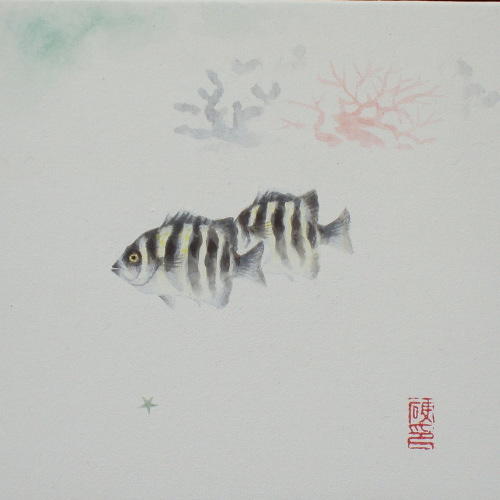
Picture: Katashi Oyama Works
Image Designer: Izumi Mori

Sunday, February 27, 2005

The Glocal Book:"The Book of Tea" by Okakura Kakuzou(Tenshin)-No.74

In the Tea-Room; The Fear of Repetition;
A Constant Presence


「In the tea-room the fear of repetition is a constant presence.

The various objects for the decoration of a room should be so selected that no colour or design shall be repeated.

If you have a living flower, a painting of flowers is not allowable.

If you are using a round kettle, the water picher should be angular.

A cup with a black glaze should not be associated with a tea-caddy of black lacquer.

In placing a vase or an incense burner on the tokonoma, care should be taken not to put it in the exact center, let it divide the space into equal halves.

The pillar of the tokonoma should be of a different kind of wood from the pillars, in order to break any suggestion of monotony in the room. 」
(From the Book of Tea-the Tea-Room, pp.71-72, Charles E. Tuttle Co., Rutland, Vermont, Tokyo, Japan)

In this chapter, you could understand the essential concepts of beauty in the tea-room decoration.

I think the most important is the essence of space dividing.

You need to remember the Abode of Vacancy.

The beauty concepts are incomplete and unsymmetrical in the dynamic, temporal aesthetic mood.

Click Please!! Listed on BlogShares


Picture: hare by katashi Oyama
Image Designer: Izumi Mori

Friday, February 25, 2005

The Glocal Book:"The Book of Tea" by Okakura Kakuzou(Tenshin)-No.73

In the Tea-Room; Uniformity of Design:
Fatal to the Freshness of Imagination


「The Virility of the life and art lay in its possibilities for growth.

In the tea-room it is left for each guest in imagination to complete the total effect in relation to himself.

Since Zennism has become the prevailing mode of thought, the art of the extreme Orient has purposely avoid the symmetrical as expressing not only completion, but repetition.

Uniformity of design was considered as fatal to the freshness of imagination.

Thus, landscapes, birds, and flowers became thr favourite subjects for depiction rather than the human figure, the latter being present in the person of the beholder himself.

We are often too much in evidence as it is, and in spite of our vanity even self-regard is apt to became monotonous. 」
(From the Book of Tea-the Rea-Room, pp.70-71, Charles E. Tuttle Co., Rutland, Vermont, Tokyo, Japan)

The art must lay in the immortality for growth.

In its sence, uniformity of design is fatal to the freshness of immagination.

Now, I think youll' be able to understand the beauties ," the Abode of the Unsymmetrical & Incomplete".

Click Please!! Listed on BlogShares


Picture: Striped Porgy by Katashi Oyama
Image Designer: Izumi Mori

Thursday, February 24, 2005

The Glocal Book:"The Book of Tea" by Okakura Kakuzou(Tenshin)-No.72

The Abode of the Unsymmetrical; True Beauty;
Complete The Incomplete Mentally

「The "Abode of the Unsymmetrical" suggests another phase of our decorative scheme.

The absence of smmetry in Japanese art objects has been often commented on by Western critics.

This, also, is a result of a working out through Zennism of Taoist ideals.

Confucianism, with its deep-seated ideas of dualism, and Northern Buddhism with its workship of a trinity, were in no way opposed to the expression of symmetry.

As a matter of fact, if we study the ancient bronzes of China or the religious arts of the Tang dynasty and the Nara period, we shall recognise a constant striving after symmetry.

The decoration of our classical interors was decidedly regular in its arrangement.

The Taoist and Zen conception of perfection, however, was different.

The dynamic natere of their philosophy laid more stress upon the process through which perfection was sought than upon perfection itself.

True beauty could be discovered only by one who mentally completed the incomplete.」
(From the Book of Tea-the Tea-Room, pp.69-70, Charles E, Tuttle Co., Rutland, Vermont, Tokyo, Japan)

This section is very important to understand the "Abode of the Unsymmetrical".

The concepts are the result of workings out through Zennism of Taoist ideals.

Click Please!! Listed on BlogShares

The Glocal Book:"The Book of Tea" by Okakura Kakuzou(Tenshin)-No.71

The Tea-Room; Absolutly Empty,
Except for Satisfying Some Aesthetic
Mood Temporarily


「The term, Abode of Vacancy, besides conveying the Taoist theory of the all-containing, involves the conception of a continued need of change in decorative motives.

The tea-room is empty, except for what may be placed there temporarily to satisfy some aesthetic mood.

Some special art object is brought in for the occation, and everything else is selected and arranged to enhance the beauty of the principal theme.

One cannot listen to different piecec of music at the same time, a real comprehention of the beatiful being possible onlty through concentration upon some motive.

Thus it will be seen that the system of decoration in our tea-rooms is opposed to that which obtains in the West, where the interior of a house is often converted into a museam.

To a Japanese, accustomed to simplicity of ornamentation and frequent change of decorative method, a Western interior permanently filled with a vast array of pictures, statuary,
and bric-'a-brac gives the impression of mere vulgar display of riches.

It calls for a mighty wealth of appreciation to enjoy the constant sight of even a masterpiece, and limitless indeed must be the capacity for artistic feeling in the those who can exist day after day in the midst of such confusion of colour and form as is to be often seen in the homes of Europe and America.」
(From the Book of Tea-theTea-Room, pp.68-69, Charles E. Tuttle Co., Rutland, Vermont, Tokyo, Japan)

It is very interesting for the different appreciations for the decoration in rooms between Japan and Europe and America .

In Japan, it's simplicity of ornamentation and frequent frequent changes of decorations.

In Westen, it's the permanent fullfill with a vast array of interior goods.

Click Please!! Listed on BlogShares


Picture: Striped Porgy by Katashi Oyama
Image Designer: Izumi Mori

Wednesday, February 23, 2005

The Glocal Book:"The Book of Tea" by Okakura Kakuzou(Tenshin)-No.70

The Tea-Room; The Enforcement of
the Principle of Vitality in Art


「That the tea-room should be built to suit some individual taste is an enforcement of the principle of vitality in art.

Art, to be fully appreciated, must be true to contemporaneous life.

It is not that we should ignore the claims of posterity, but that we should seek to enjoy the present more.

It is not that we should disregard the creations of the past, but that we should try to assimilate them into our consciousness.

Slavish conformity to traditions and formulas fetters the expression of individuality in architecture.

We can but weep over those senseless imitations of European buildings which one beholds in modern Japan.

We marved why, among the most progressive Western nations, architecture should be so devoid of originality, so replete with repetitions of obsolete styles.

Perhaps we are now passing through an age of demonstration in art, while awaiting the rise of some princely master who shall establish a new dynasty.

Would that we loved the ancients more and copied them less!

It has been said that the Greeks were great because they never drew from the antique.」
(From the Book of Tea-the Tea-Room, pp.67-68 , Charles E. Tuttle Co., Rutland, Vermont, Tokyo, Japan)

Not only the Tea-Room, the principle of the way of tea must be creative to all sorts of individual performances.

You have to be philosophical and artistic for enjoying tea drinking and for the life of art.

Click Please!! Listed on BlogShares


Picture: Blue - Green Glazed Square Platter by keitoku Kato
Image Designer: Izumi Mori

Monday, February 21, 2005

The Glocal Book:"The Book of Tea" by Okakura Kakuzou(Tenshin)-No.69

The Temporary Refuge;
With the Subtle Light of the Refinement


「With the predominance of Zen individualism in the fifteenth century, however, the old idea became imbued with a deeper significance as conceived in connection with the tea-room.

Zennism, with the Buddist theory of evanescence and its demands for the mastery of of spirit over matter, recognised the house only as a temporary refuge for the body.

The body itself was but as a hut in the wilderness, a flimsy shelter made by tring together the grasses that grew around,---when these ceased to be bound together they again became resolved into the original waste.

In the tea-room fugitiveness is suggested in the thatched roof, frailty in the slender pillars, lightness in the bamboo support, apparent carelessness in the use of common place materialals.

The eternal is to be found only in the spirit which, embodied in these simple surroundings, beutifies them with the subtle light of its refinement.」
(From the Book of Tea-the Tea-Room, pp.66-67, Charles E. Tuttle Co., Rutland, Vermont, Tokyo, Japan)

Now, I think you can understand the spiritual back ground of The Tea-Room.

I hope you read through carefully in this parts of sentences.

Click Please!! Listed on BlogShares


Picture: Olibe Glazed Crock by Keitoku Kato
Image Designer: Izumi Mori

The Glocal Book:"The Book of Tea" by Okakura Kakuzou(Tenshin)-No.68

Abode of Fancy; Implies a Structure Created to Meet Some Individual Artistic Requirement


「The name, Abode of Fancy, implies a structure created to meet some individual artistic requirement.

The tea-room is made for the tea-master, not the tea-master for the tea-room.

It is not intended for posterity and is therefore ephemeral.

The idea that everyone should have a house of his own is based on an ancient custom of the Japanese race, Shinto superstition ordering that every dwelling should be evacuated on the death of its chief occupant.

Perhaps there may have been some unrealised sanitary reason for this practice.

Another early custom was that a newly built house should be provided for each couple that married.

It is account of such customs that we find the Imperial capitals so frequently removed from one site to another in ancient days.

The rebuilding every twenty years of Ise Temple, the supreme shine of the Sun-Goddeass, is an exanple of one of these ancient rites which still obtain at the present day.

The observance of these customs was only possible with some such form of construction as that furnished by our system of wooden architecture, easily pulled down, easily built up.

A more lasting style, employing brick and stone, would have rendered migrations impracticable, as indeed they became when the more stable and massive wooden construction of China was adopted by us after the Nara period.」
(From thr Book of Tea-the Tea-Room, pp.65-66, Charles E. Tuttle Co., Rutland, Vermont, Tokyo, Japan)

Essential spiritual mind of the way of tea is individualism and very personal.

Yet, I think the mind was changed to "fall into the habit of learning the process of the way of tea without philosophical search.


Click Please!! Listed on BlogShares


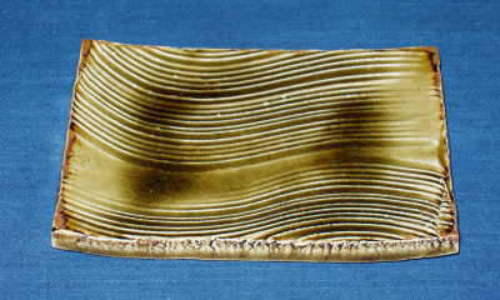
Picture: Ash-Glazed Combed Pattern Rectangular
Image Designer: Izumi Mori