Wednesday, February 09, 2005

The Glocal Book:"The Book of Tea" by Okakura Kakuzou(Tenshin)-No.58

The Foundations of Tea-Ceremony


「We have already said that it was the ritual instituted by the Zen
monks of successively drinking tea out of a bowl before the image of Bodhi Dharma, which laid the foundations of the tea-ceremony.

We might add here that the altar of the Zen chapel was the prototype
of the Tokonoma,--The place of honour in a Japanese room where paintings and flowers are placed for the edification of the guests.」
(From the Book of Tea-the Tea-Room, p.59, Charles E. Tuttle Co., Rutland, Vermont-Tokyo, Japan)

Today, we know the relation between the tea- ceremony and the Zen.

I think you understand the foundations of the way of tea in relation to drink tea.

In addition, we realize the prototype of the Tokonoma.

Click Please!! Listed on BlogShares


Picture: Old Seto Glazed Long Neck look like Crane Crock by Keitoku Kato
Image Designer: Izumi Mori
Tuesday, February 08, 2005

The Glocal Book:"The Book of Tea" by Okakura Kakuzou(Tenshin)-No.57

The Simplicity & Purism of the Tea-Room;
Bare : The Zen Monastery


「The simplicity and purism of the tea-room resulted from emulation of the Zen monastery.

A Zen monastery differs from those of other Buddhist sects inasmuch as it is meant only to be a dwelling place for the monks.

Its chapel is not a place of worship or pilgrimage, but a college room where the students congregate for discussion and the practice of meditation.

The room is bare except for a central alcove in which, behind the altar, is a statue of Bodhi Dharma, the founder of the sect, or of Sakyamuni attended by Kashiapa and Ananda, the two earliest Zen patriarchs.

On the altar, flowers and incence are offered up in memory of the great contributions which these sages made to Zen」
(From the Book of Tea-the Tea-Room, pp.58-59, Charles E. Tuttle Co., Rutland, Vermont-Tokyo, Japan)

The Tea-Room is enough to be bare to drink tea and to discuss about the right way of life.

If you are trying to drink tea alone, the empty Tea-Room is best for the practice of meditation.

You could concentrate on the deep pure meditation.

Click Please!! Listed on BlogShares


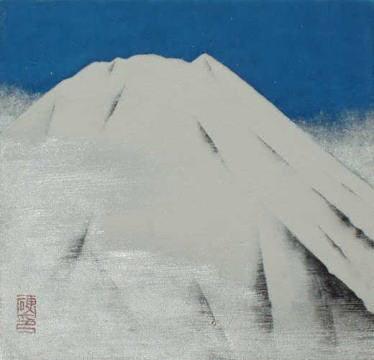
Picture: Mt.fuji by Katashi Oyama
Image Designer: Izumi Mori

Monday, February 07, 2005

The Glocal Book:"The Book of Tea" by Okakura Kakuzou(Tenshin)-No.56

The Durability of Japanese Wooden Architecture

「In the Golden Hall of Horiuji and the Pagoda of Yakushiji, we have noteworthy examples of the durability of our wooden architecture.

These buildings have practically stood intact for nealy twelve centuries.
The interior of the old temples and palaces was profisely decorated.

In the Hoodo temple at Uji, dating from the tenth century, we can still see the elaborate canopy and gilded baldachinos, many-coloured and inlaid with mirrors and mother-of-pearl, as well as remains of the paintings and sculpture which formerly covered the walls, at Nikko and in the Nijo castle in Kyoto, we see structural beauty sacrificed to a wealth of ornamentation which in colour and exquisite detail equals the utmost gorgeousness of Arabian or Moorish effort.」
(From the Book of Tea-The Tea-Room, pp.57-58, Charles E. Tuttle Co., Rutland, Vermont, Tokyo, Japan)

You are still able to visit and look at The old temple of Horiuji and the Pagoda of Yakushiji .

The facts mean they are durable for almost 1300 years.

Yet, you'll find much more older building in Egypt and Greek.
These Japanese old Temples are completely different from the history of Tea-Room.

Click Please!! Listed on BlogShares

Saturday, February 05, 2005

The Glocal Book:"The Book of Tea" by Okakura Kakuzou(Tenshin)-No.55

The smallest Tea-House; Differ from
the Classical Architecture of Japan Itself


「The tea-room is not only different from any production of Western architecture, but also contrasts strongly with the classical architecture of Japan itself.

Our ancient noble edifices, whether secular or ecclesiastical, were not to be despised even as regards their mere size.

The few that have been spared in the disastrous conflagrations of centuries are still capable of aweing us by the grandeur and richness of their decoration.

Huge pillars of wood from two to three feet in diameter and from thirty to forty feet high, supported, by a complicated network of brackets, the enormous beams which groaned under the weight of the tile-covered slanting roofs.

The material and mode of construction, through weak against fire, proved itself strong against earthquakes, and well suited to the climatic conditions of the country.」
(From the Book of Tea-The Tea-Room, p.57, Charles E. Tuttle Co., Rutland, Vermont, Tokyo, Japan)

Okakura mentioned that the architecture of the Tea-Room is differ from those of the Western and Japanese.

Yet, I think it not necessarily right.

You should not consider from the historical monuments you could find present days.

The origin of the Tea-Room is from the common and general poor farmer's houses, which have destroyed without any historical monument.

Click Please!! Listed on BlogShares


Picture: Mt.Fuji by Katashi Oyama
Image Designer: Izumi Mori

The Glocal Book:"The Book of Tea" by Okakura Kakuzou(Tenshin)-No.54

The Tea-Room; The Smallest of Japanese House


「The tea-room is unimpressive in appearance.

It is smaller than the smallest of Japanese houses, while the materials used in its construction are intended to give the suggestion of refined poverty.

Yet we must remember that all this is the result of profound artistic forehought, and that the details have been worked out with care perhaps even greater than that expended on the building of the richest palaces and temples.

A good tea-room is more costly than an ordinary mansion, for the selection of its materials, as well as workmanship, requires immense care and precision.

Indeed the carpenters employed by the tea-masters form a distinct and highly honoured class among artisans, ther work being no less delicate than that of the makers of lacquer cabinets.」
(From the Book of Tea-The Tea-Room, pp.56-57, Charles E. Tuttle Co., Rutland, Vermont-Tokyo, Japan)

I think the characteristics of The Tea-Room are as follows.

In The smallest Tea-Room, just two persons could sit down at once. The one is guest and the other is host. One of the first and historically famous Tea-Room of the samllest one was said to be built by Senno-Soyeki(Rikiu).

The small houses were generally for poor farmer, which is sufficient to drink tea.

The spiritual mind for drinking tea is just sit down to drink tea.

You should understand the essential mind as follows.

It's just enough to put a pot over the fire and pour hot water to a teacup.

In that sence, I don't prefer to spend much money to build The Expensive The Tea-House.

Yet, don't forget the essence of The Smallest Tea-House should be unsymmetric and imperfect.

Click Please!! Listed on BlogShares

Thursday, February 03, 2005

The Glocal Book:"The Book of Tea" by Okakura Kakuzou(Tenshin)-No.53

The Sukia

「The early tea-room consisted merely of a portion of the ordinary drawing-room partitioned off by screens for the purpose of the tea-gathering.

The portion partitioned off was called the Kakoi(enclosure), a name still appllied to those tea-rooms which are built into a house and are not indipendent constructions.

The Sukia consists of the tea-room proper, desiggned to accommodate not more than five persons, number suggestive of the saying "more than the Graces and less than the Muses," an anteroom(midsuya) where the tea utensils are washed and arranged before being brought in, a portico(machiai) in which the guests wait until they receive the summons to enter the tea-room, and a garden path(the roji) which connects the machiai with the tea-room.」
(From the Book of Tea-The Tea-Room, pp. 55-56, Charles E. Tuttle Co., Rutland, Vermont-Tokyo, Japan)

At present days, most of japanese may not understand The Sukia.

Because, modern japanese houses do not arrange such sorts of pace and/or room.

And it's quite rare to use such sorts of facilites at daily life of avarage japanese people.

Yet, I think they should understand the conveniences and rationality of the facilities.

The origin of The Sukia is based on the country and/or farmer's house.

I believe The Sukia has the glocal characteristics of Japanese house.


Click Please!! Listed on BlogShares

The Glocal Book:"The Book of Tea" by Okakura Kakuzou(Tenshin)-No.52

The First Tea-Room


「The first independent tea-room was the creation of Senno-Soyeki, commonly known by his later name of Rikiu, the greatest of all tea-masters, who, in the sixteenth century, under the patronage of Taiko-Hideyoshi, instituted and brought to a high state of perfection the formalities of the Tea-ceremony.

The proportions of the tea-room had been previously determined by Jowo-a famous tea-master of the fifteen century 」
(From the Book of Tea-The Tea-Room, p.55, Charles E. Yuttle Co., Rutland, Vermont-Tokyo, Japan)

The tea-room has the symbol of Tea-ceremony.

The first style of tea-room was supposed to be determined by Takeno-Jowo, who teached Senno-Soyeki.

However, at the generation of Ashikaga of early fifteen centyries, Shogun Ashikaga-Yoshinori was the first to set the tea-room at his palace.

Late fifteenth, Shogun Ashikaga- Yoshimasa was the most contributer and creater to develop the tea-culture. Famous temple Ginkakuji at Kyoto district was the center of the culture, we call Higashiyama bunka(culture) .
The name of house, Higashiyama-Sansou might be the kind of salon and enjoyed the tea as the first isolated tea-room, which was larger than those of Senno-Soyeki.

Takeno-Jowo learned tea related culture from Shogun Ashikaga Yoshimasa group.

Click Please!! Listed on BlogShares


Picture: Dark Green - Iron Glazed Crock by Keitoku Kato
Image Designer: Izumi Mori

Tuesday, February 01, 2005

The Glocal Book:"The Book of Tea" by Okakura Kakuzou(Tenshin)-No.51

The Tea-Room;
The Abode of the Unsymmetrical; The Imperfect


「The tea-room(the Sukiya) does not pretend to be other than a mere cottage-a straw hut, as we call it.
The original ideographs for Sukiya mean the Above of Fancy.
Latterly the various tea-masters substituted various Chinese charactets according to their conception of the tea-room, and the term Sukiya may signify the Above of Vacancy of the Abode of the Unsymmetrical.
It is an Abode of Fancy insamuch as it is an ephemeral structure built to house a poetic impulse.
It is an Abode of Vacancy inasmuch as it is devoid of ornamentation except for what may be placedin it to satisfy some aesthetic need of the moment.
It is an Abode of the Unsymmetrical inasmuch as it is consecrated to the workship of the Imperfect, purposely leaving some thing unfinished for the play of the imagination to complete.
The ideals of Teaism have since the sixteenth century influenced our architecture to such a degree that the ordinary Japanese inferior of the present day, on account of the extreme simplicity and chasteness of it scheme of decoration, appears to foreigner almost barren.」
(From the Book of Tea-The Tea-Room, pp.54-55, Charles E. Tuttle Co., Rutland, Vermont-Tokyo, Japan)

From the above descrived sentences, you, who have never looked and lived in Japanese-style house, might be difficult to image and to find the artistic feeling.

I think the essential artistic values are in the Abode of Unsymmetical Simplicity and the Imperfect sence to the imaginatory stimulation of completion.

Click Please!! Listed on BlogShares


Picture: Olibe Glazed Crock by keitoku Kato
Image Designer: Izumi Mori

The Glocal Book:"The Book of Tea" by Okakura Kakuzou(Tenshin)-No.50

The Subtle Beauty of the Tea-Room


「To European architects brought up on the traditions of stone and brick construction, our Japanese method of building with wood and bamboo seems scarcely worthy to be ranked as architecture.

It is but quite recently that a competent student of Western architecture has recognised and paid tribute to the remarkable perfection of our great temples.

Such being the case as regards our classic architecture, we could hardly expect the outer to appreciate the subtle beauty of the tea-room, its principles of construction and decoration being entirely different from those of the West. 」
(From the Book of Tea-The Tea-Room, pp.53-54, Charles E. Tuttle Co., Rutland, Vermont-Tokyo, Japan)

Today, we will move to the Chapter ; The Tea-Room.
The architecture for Tea-Room is our traditional house builing.

I think the beaty of the Japanese house is based on the simplicity and unsymmetricity.
The Japanese house is basically made of wood and you will be able to enjoy the different kinds of touch, charm and beauty of the house with aging.

Click Please!! Listed on BlogShares


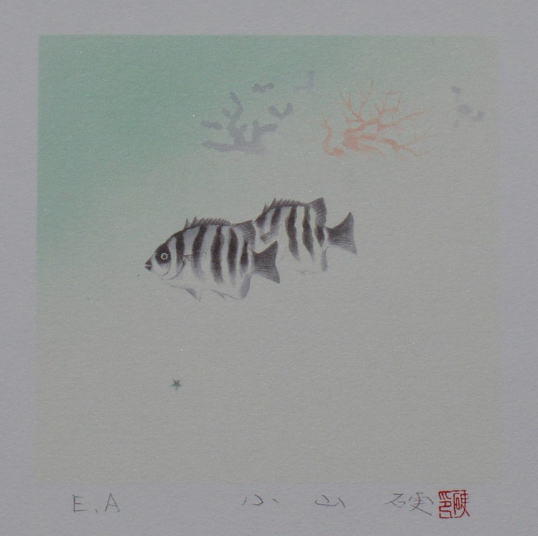
Picture: Striped Porgy by Katashi Oyama
Image Designer: Izumi Mori

Sunday, January 30, 2005

The Glocal Book:"The Book of Tea" by Okakura Kakuzou(Tenshin)-No.49

The Whole Ideal of Teaism is a Result of
Zen Conception of Greatness
in the Smallest Incidents of Life


「A special contribution of Zen to Eastern thought was its recognition of the mundane as of equal importance with the spiritual.

It held that in the great relation of things there was no distinction of small and great, an atom possessing equal possibilities with the universe.

The seeker for perfection must discover in his own life the reflection of the inner light.

The organisation of the Zen monastery was very significant of this point of view.
To every member, except the abbot, was assigned some special work in the care-taking of the monastery, and curiously enough, to the voices were committed the lighter duties, while to the most respected and advanced monks were given the more irksome and menial tasks.
Such serices formed a part of the Zen discipline and every least action must be done absolutely perfectly.
Thus many a weighty discussion ensued while weeding the garden, paring a turnip, or serving tea.

The whole ideals of Teaism is a result of this Zen conception of greatness in the smallest incidents of life.

Taoism furnished the basis for aesthetic ideals, Zennism made them practical.」
(From the Book of Tea-Taoism and Zennism, pp.51-52, Charles E. Tuttle Co., Rutland, Vermont-Tikyo, Japan)

Today's description is the summary of Taoism and Zennism related to Teaism.

Okakura described that Taoism furnished the basis for aesthetic ideals, Zennism made them practical.

As its practical way of human lifestyle, we drink tea to search aesthetic ideals and practical performance of greatness in daily life, even in the smallest incidence.

Click Please!! Listed on BlogShares


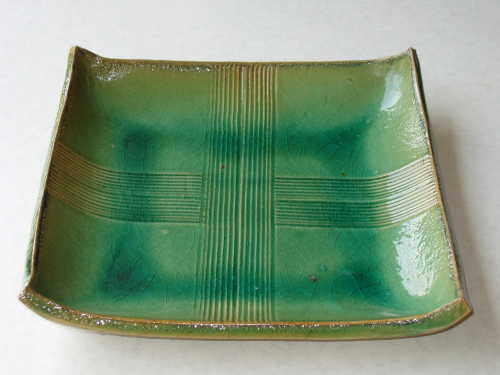
Picture: Blue - Green Glazed Square Platter by Keitoku Kato
Image Designer: Izumi Mori

The Glocal Book:"The Book of Tea" by Okakura Kakuzou(Tenshin)-No.48

Outward Accessories;
Impediments to a Clear Perception of Truth


「Zen was often opposed to the precepts of orthodox Buddhism even as Taoism was opposed to Confucianism.
To the transcendental insight of Zen, words were but an incumbrance to thought; the whole sway of Buddist scriptures only commentaries on personal speculation.
The followers of Zen aimed at direct communication with the inner nature of things, regarding their outward accessories only as impediments to a clear perception of Truth.
It was this love of the Abstract that led the Zen to prefer black and white sketches to the elaborately coloured paintings of the classic Buddist School.
Some of the Zen even became iconoclastic as a result of their endeavour to recognise the Buddha in themselves rather than through images and symbolism.
We find Tankawosho breaking up a wooden statue of Buddha on a wintry day to make a fire.
"What sacrilege!" said the horror-stricken bystander.
"I wish to get the Shali out of the ashes," calmly rejoined the Zen.
"But you certainly will not get Shali from this images!" was the angry retort, to which Tanka replied, "If I do not, this is certainly not a Buddha and I am committing no sacrilege."
Then he turned to warm himself over the kindling fire. 」
(From the Book of Tea-Taoism and Zennism, pp.50-51, Charles E. Tuttle Co.,Rutland Vermont-Tokyo, japan)

Zen signifies consecrated Meditation to reach supreme self-recognition and advocates strong individualism.

The Zen ask the direct communication with the inner nature things.

The facts resut to mean the Buddist scriptures, images and symbolism of Buddha are their outward accessories, which are impediments to a clear perception of Truth.

Click Please!! Listed on BlogShares


Picture: Kayokukan by Katashi Oyama
Image Designer: Izumi Mori

Saturday, January 29, 2005

The Glocal Book:"The Book of Tea" by Okakura Kakuzou(Tenshin)-No.47

Zennism; Truth Through
the Comprehension of Opposites

「Zennism, like Taoism, is the worship of Relativity.
One master defines Zen as the art of feeling the polar star in the southern sky.
Truth can be reached only through the comprehension of opposites.
Again, Zennism, like Taoism, is a strong advocate of individualism.
Nothing is real except that which concerns the working of our own minds.

Yeno, the sixth patriach, once saw two monks watching the flag of a pagoda fluttering in the wind.
One said "It is the wind that moves," the other said "It is the flag that moves" ; but Yeno explained to them that the real movement was neither of the wind nor the flag, but of something within their own minds.

Hiakujo was walking in the forest with a disciple when a hare scurried off at their approach.
"Why does the hare fly from you?" asked Hiakujo.
"Because he is afraid of me," was the answer.
"No," said the master, "it is because you have a murderous instinct."

This dialogue recalls that of Soshi(Chuangtse), the Taoist.
One day Soshi was walking on the bank of a river with a friend.
"How delightfully the fishes are enjoying themselves in the water!" exclaimed Soshi. His friend spake to him thus: "You are not a fish; how do you know that the fishes are enjoying themselves?"
"You are not myself," returned Soshi; "how do you know that I do not know that the fishes are enjoying themselves?"」
(From the Book of Tea-Taoism and Zennism,pp.49-50,
Charles E. Tuttle Co.,Rutland, Vermont-Tokyo, Japan)

In this chapter, the points are as follows.
1) Zennism, as well as Taoism, is the worship of Relativity and is a strong advocate of individualism.
2) Truth can be reached only through the comprehension of opposites.

As you know, the title of this Blog is "Snoberry Rhapsody Over Beyond the Pros & Cons".
Yet, the purpose of this Blog is "Let's search for Glocal Lifestyles"," which is based on eternal truth."

How do you think?

Click Please!! Listed on BlogShares

Friday, January 28, 2005

The Glocal Book:"The Book of Tea" by Okakura Kakuzou(Tenshin)-No.46

Zenn; The History of the Patriarchs & the Doctrines


「The first teaching of Zen as you know it at the present day must be attributed to the sixth Chinese patriarch Yeno(637-713), founder of Southern Zen, so-called from the fact of its predominance in Southern China.
He is closely followed by the great Baso (died 788) who made of Zen a living influence in Celestial life.
Hiakujo(719-814), the pupil of Baso, first instituted the Zen monastery and established a ritual and regulations for its gpvernment.
In the discussions of Zen school after the time of Baso we find the play of the Yangtse-Kiang mind causing an accession of native modes of thought in contrast to the former Indian idealism.
Whatever sectarian pride may assert to the contrary, one cannot help being impressed by the similarity of Southern Zen to the teachings of Laotse, and the Taoist Conversationalists.
In the Taoteiking we already find allusions to the importance of self-concentration and the need of properly regulating the breath-essential points in the practice of Zen meditation.
Some of the best commentaries on the Book of Laotse have been written by Zen scholars.」
(From the Book of Tea-Taoism and Zen, pp.48-49, Charles E. Tuttle Co., Rutland, Vermont-Tokyo, Japan)

Let's remember the previous sentences.
「Zen is a name derived from the Sanscrit word Dhyana, which signifies " Meditation".
It claims that through consecrated meditation may be attained supreme self-realisation」

Just, I like to consecrate to Meditation.

Click Please!! Listed on BlogShares


Picture: Mt.Fuji by Katashi Oyama
Image Designer: Izumi Mori

Thursday, January 27, 2005

The Glocal Book:"The Book of Tea" by Okakura Kakuzou(Tenshin)-No.45

Zen; Supreme Self-Realisation


「If now we turn our attention to Zennism we shall find that it emphasises the teachings of Taoism.
Zen is a name derived from the Sanscrit word Dhyana, which signifies meditation.
It claims that through consecrated meditation may be attained supreme self-realisation.
Meditation is one of the six ways through which Buddhahood may be reached, and the Zen sectatians affirm that Sakyamuni laid special stress on this method in his later teachings, handing down the rules to his chief disciple Kashipa.
According to their tradition Kashipa, the first Zen patriarch, imparted the secret to Ananda, who in turn passed it on to successive patriachs until it reached Bodhi-Dharma, the twenty-eighth.
Bodhi-Dharma, came to Northern China in the early half of the sixth century and was the first patriarch of Chinese Zen.
There is much uncertainty about the history of these patriarchs and their doctrines.
In its philosophical aspect early Zennism seems to have affinity on one hand to the Indian Negativism of Nagarjuna and on the other to the Gnan philosophy formulated by Sancharacharya.」
(From the Book of Tea-Taoism and Zennism, p.47-48, Charles E. Tuttle Co., Rutland, Vermont-Tokyo, Japan)

Now, we are going to study about Zen, which is the most deeply affect to The Way of Tea and/or The Tea Ceremony.

First of all, let's learn about the history of Zen.
Yet, there is much uncertainty about the early phase of Zen history.

Click Please!! Listed on BlogShares

Wednesday, January 26, 2005

The Glocal Book:"The Book of Tea" by Okakura Kakuzou(Tenshin)-No.44

The Master of the Art of Living ;
Pity, Economy, Modesty


「He who had made himself master of the art of living was the Real Man of the Taoist.
At birth he enters the realm of dreams only to awaken to reality at death.
He tempers his own brightness in order to merge himself into the obscurity of others.
He is "reructant, as one who crosses a stream in winter; hesitating, as one who fears the neighbourhood; respectful, like a guest; trmbling, like ice that is to melt; unassuming, like a piece of wood not yet carved; vacant, like a valley; formless, like troubled waters."
To him the three jewels of life were Oity, Economy, and Modesty.」
(From the Book of Tea-Taoism and Zennism, pp.46-47, Charles E. Tuttle Co., Rutland, Vermont-Tokyo, Japan)

I would like to wander and struggle asking and seaching the eternal truth.

Therefore, I prefer to sing the famous song(Bob Dylan).
" How many roads must a man walk down Before you call him a man? Yes,'n' how many seas must a white dove sail Before she sleeps in the sand? Yes,'n' how many time must the cannon balls fly Before they're forever banned? The answer, my friend, is blowin' in the wind. The answer is blowin'in the wind."

Click Please!! Listed on BlogShares


Picture: Striped Porgy by Katashi Oyama
Image Designer: Izumi Mori

Tuesday, January 25, 2005

The Glocal Book:"The Book of Tea" by Okakura Kakuzou(Tenshin)-No.43

The Vacuum; Japanese Theories of Action


「These Taoist' ideas have greatly influenced all our theories of action, even to those of fencing and wrestling.
Jiu-jitsu, the Japanese art of self-defence, owes its name to a passage in the Taoteiking.
In jiu-jitsu one seeks to draw out and exhaust the enemy's strength by non-resistance, while conserving one's own strength for victory in the final struggle.
In art the importance of the same principle is illustrated by the value of suggestion.
In leaving something unsaid the beholder is given a chance to complete the idea and thus a great masterpiece irresistibly rivets your attention until you seem to become actually a part of it.
A vacuum is there for you to enter and fill up to the full measure of your aesthetic emotion.」(
From the Book of Tea-Taoism and Zennism, p.46, Charles E. Tuttle Co., Rutland, Vermont-Tokyo, Japan)

As already you know, Taoism is Chinese origin and has long history.
The Taoism and related philosophy such as Zennism have deeply influenced to Japanese culture.

The Tea Drinkings including The Way of Tea and Tea Cult had principally owed to the Taoism and Zennism.

Click Please!! Listed on BlogShares


Picture: Blue - Green Glazed Square Plate by Keitoku Kato
Image Designer: Izumi Mori

Sunday, January 23, 2005

The Glocal Book:"The Book of Tea" by Okakura Kakuzou(Tenshin)-No.42

The Vacuum ; the Whole Can Always
Dominate the Part


「The Taoists claimed that the comedy of life could be made more interesing if everyone would preserve the unities.
To keep the proportion of things and give place to others without losing one's own position was the secret of success in the mundane drama.
We must know the whole play in order to properly act our parts; the conception of totality must never be lost in that of the individual.
This Laotse illustrates by his favourite metaphor of the Vacuum.
He claimed that only in vacuum lay the truly essential.
The reality of a room, for instance, was to be found in the vacant space enclosed by the roof and walls, not in the roof and wales themselves.
The usefulness of a water pitcher dwelt in the empitiness where water might be put, not in the form of the pitcher or the material of which it was made.
Vacuum is all potent because all containing.
In vacuum alone motion becomes possible.
One who could make of himself a vacuum into which others might freely enter would become master of all situations.
The whole can aiways dominate the part.」
(From the Book if Tea-Taoism & Zennism, pp.44-45,
Charles E. Tuttle Co., Rutland, Vermont-Tokyo, Japan)

It is easy to understand that the whole always dominate the part.

Yet, I dare to say that the essentials always dominate the whole.
In physics, you will accept the facts that quantum mechanics dominates Newton physics.
Quantum mechanics is dominated by nuclear physics.

Glocal culture is based on local culture.

Click Please!!Listed on BlogShares


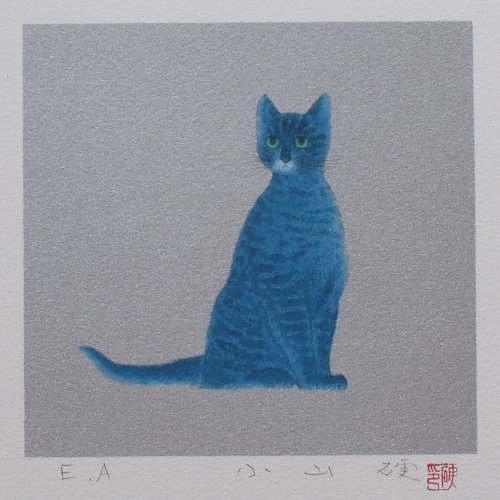
Picture: Russianblue by Katashi Oyama
Image Designer: Izumi Mori

Saturday, January 22, 2005

The Glocal Book:"The Book of Tea" by Okakura Kakuzou(Tenshin)-No.41

The Legitimate Sphere of the Relative


「But the chief contribution of Taoism to Asiatic life has been in the realsm of aesthetics.
Chinese historians have always spoken of Taoism as the "art of being in the world," for it deals with the present-ourselves.
It is in us that God meets with Nature, and yesterday parts from to-morrow.
The Present is the moving Infinity, the legitimate sphere of the Relative.
Relativity seeks Adjustment; Adjustment is Art.
The art of life lies in a constant readjustment to our surroundings.
Taoism accepts the mundane as it is and, unlike the Confucians and the Buddists, tries to find beauty in our world of woe and worry.
The Sung allegory of the Three Vinegar Tasters explains admirably the trend of the three doctrines.
Sakyamuni, Confucius, and Laotose once stood before a jar of vinegar-the emblem of life- and each dipped in his fingers to taste the brew.
The matter-of- fact Confucius found it sour, the Buddha called it bitter, and Laotose pronounced it sweet.」
(From the Book of Tea-Taoism and Zennism, p.44, Charles E. Tuttle Co., Rutland, Vermont-Tokyo, Japan)

How do you answer if you dipped your finger to taste a vinegar?

I would like to answer the taste as it is.

I think there is the possibility the vinegar is sour, bitter or sweet depend on what kind of vineger you tasted.
The fact means you don't know who is honest to answer.

The feeling of taste will be also different depending on how much you tasted at once.
Therefor, you have to adjust the quontity of vinegar and taste at once.
It means every one have to taste at the same condition- need to adjust the sciantific condition.

Do you think Okakura Kakuzou had the special intention to the expression of "found", "called" and "pronounced" ?

The matter-of -fact, I am not sure how do I understand the characters of three, Confucious, Buddha and Laotse.

Click Please!!Listed on BlogShares


Picture: Blue - Green Glazed Square Platter by Keitoku Kato
Image Designer: Izumi Mori

Thursday, January 20, 2005

The Glocal Book:"The Book of Tea" by Okakura Kakuzou(Tenshin)-No.40

In a Wealth of Imagery


「Chinese history is full of instances in which the votaries of Taoism, princes and hermits alike, followed with varied and interesting results the teachings of their creed.
The tale will not be without its quota of instruction and amusement.
It will be rich in anecdotes, allegories, and aphorisms.
We would fain be on speaking terms with the delightful emperor who never died because he never died.
We may ride the wind with Liehtse and find it absolutely quiet because we outselves are the wind, or dwell in mid-air with the Aged One of the Hoang-Ho, who lived betwixt Heaven and Earth because he was subject to neither the one nor the other.
Even in that grotesque apology for Taoism which we find inChina at the present day, we can revel in a wealth of imaginary impossible to find in any other cult.」
(From the Book of Tea-Taoism and Zennism, p.43, Charles E. Tuttle Co., Rutland, Vermont-Tokyo, Japan)

You will realise that Taoism is the social and/or spiritual basises of Chinese, Japanese and other world wide countries.
The fact means Taoism is the Glocal Culture and has the Glocal Character.
The Taoism has the effects on Superrealism and/or Surrelism of the Arts and other social matters.

Just Drinking Tea is also the Results of the Expression of Taoism and/or Zennism.

Click Please!!Listed on BlogShares


Picture: Kayokukan by Katashi Oyama
Image Designer: Izumi Mori

Wednesday, January 19, 2005

The Glocal Book:"The Book of Tea" by Okakura Kakuzou(Tenshin)-No.39

The Capacity for Reserve & Refinement


「The virility of the idea lies not less in its power of breakig through contemporary thought than in its capacity for dominating subsequent movements.
Taoism was an active power during the Shin dynasty, that epoch of Chinese unification from which we derive the name of China.
It would be interesting had we time to note its influence on contemporary thinkers, the mathematicians, writers on law and war, the mystics and alchemists and the latter nature-poets of the Yangtse-Kiang.
We should not even ignore those speculations on Reality who doubted whether a white horse was real because he was white, or because he was solid, nor the Conversationalists of the Six dynasties who, like the Zen philosophers, revelled in discussions concerning the Pure and the Abstract,
Above all we should pay homage to Taoism for what it has done toward the formation of the Celestial character, giving to it a certain capacity for reserve and refinement as "warm as jade." 」
(From the Book of Tea-Taoism and Zennism,PP.42-43, Charles E. Tuttle Co., Rutland, Vermont-Tokyo, Japan)

Since the generation of the Shin Dynasty, the first dynasty of Chinese unification, Taoism
already had an active power for the formation of the Celestial character, a certain capacity for reservation and refinement.

It's also the long story that Taoism had the effective power to Japanese philosophical basis and to the formation of the Celestial character.

Therefore, we, Japanese had the affinity to the Zennism, which resulted in the philosophical backgland of the Way of Tea, the tea-ceremony.

Click Please!!Listed on BlogShares


Picture: Red by Copper Glaze Crock by Keitoku Kato
Image Designer: Izumi Mori